Kakobuy Standing Shoe Cushioning Guide
Kakobuy Standing Shoe Cushioning Guide
Standing work shoes can't be chosen just by "soft or not." The actual problem to solve is: given a clear shift duration, walking ratio, floor hardness, and workplace requirements, how can you use kakobuy product page information and warehouse QC images to eliminate unsuitable candidates, and complete a try-on judgment within the return/exchange period.
This article is for users who need to purchase ordinary work shoes, restaurant shoes, service industry shoes, or daily commute shoes from Chinese e-commerce platforms. It is not applicable to positions that require specific certifications for impact resistance, puncture resistance, anti-static, insulation, or slip resistance; such needs should follow employer regulations and verifiable certification documents, not product titles or appearance photos.
Verification record: September 3, 2026. This article only verifies the provided platform data snapshot and specified image paths; it does not verify in real time the price, inventory, size, material, certification, seller commitments, and return/exchange policies of specific products. Therefore, all candidate products should be re-checked on the page before payment, and confirm executable actions after warehousing according to order rules.
Content production note: This article was generated by our editorial desk through an automated content process, and independently checked for factual boundaries, identity statements, image usage, and risk warnings; it does not represent that the author has personally purchased, worn, or tested the products in the article.
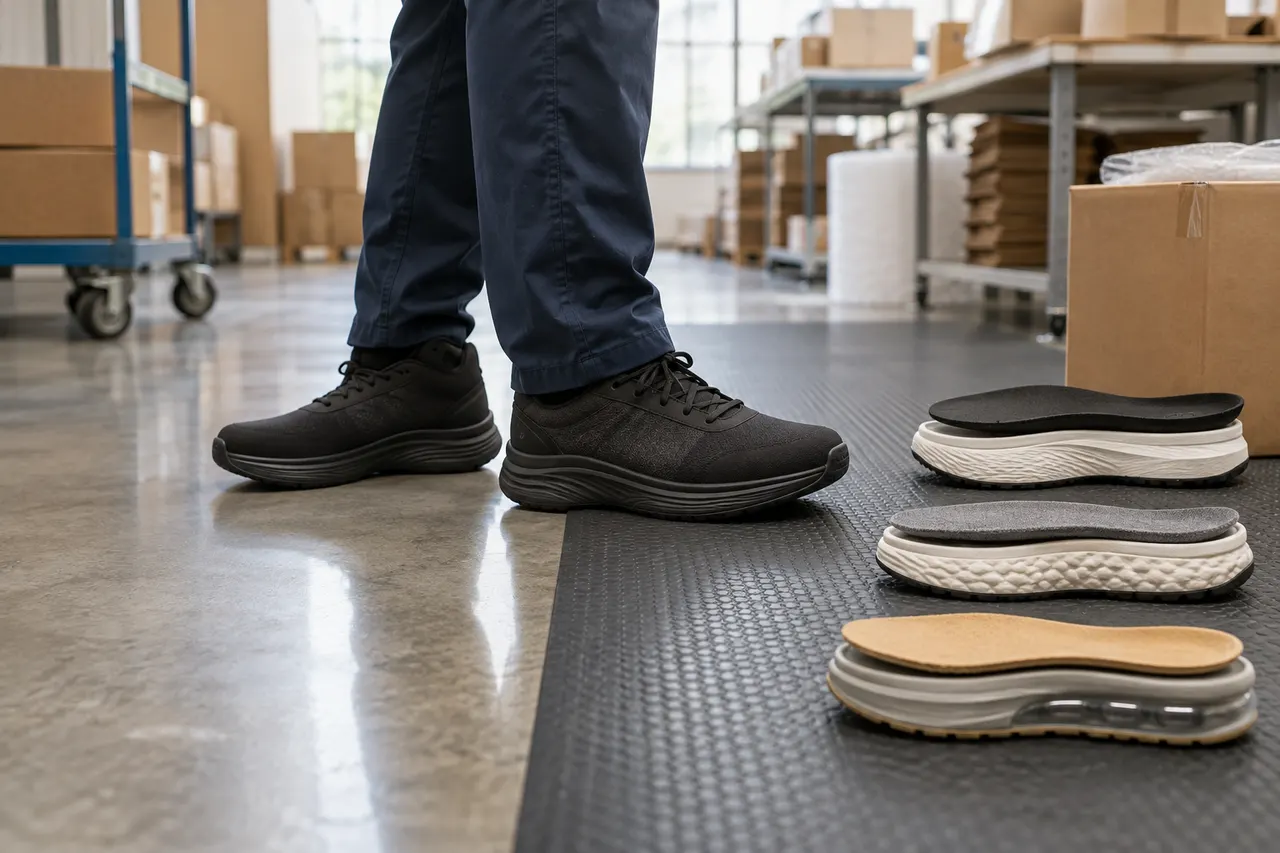
Standing work shoe screening process diagram
First write down shift duration, walking ratio, and floor type
Don't start by searching "softest work shoes"; instead, write an actual usage record 🧭:
How long is a single shift, and approximately how much time is actually spent standing
Whether each hour is mainly standing in place, short-distance turns, or continuous walking
Whether the floor is carpet, wooden floor, rubber mat, tile, or unpadded concrete
Whether there is frequent contact with water, oil, cleaning agents, high temperatures, or sharp objects
Whether the workplace specifies shoe upper color, toe cap structure, slip resistance level, or safety certification
The first discomfort of current shoes: forefoot burning, arch fatigue, heel impact, toe squeezing, or stuffiness inside the shoe
Long shifts do not automatically mean the thickest, softest shoes are needed. Standing in place on hard floors usually requires stable support and a midsole that won't collapse persistently; frequent walking also needs to consider flex position, shoe weight, heel fixation, and gait transition. When a qualified pressure-relief mat is already in place, the outsole may not need extreme thickness.
After reading this article, you should be able to leave two to three candidates with relatively complete evidence, and clearly define the exit conditions for each pair, rather than directly deciding which one is "most comfortable."
What kakobuy product information can help determine and what it cannot prove
kakobuy's platform identity is a purchasing agent and freight service connecting overseas buyers with Chinese e-commerce products. When choosing shoes, product pages, agent orders, and warehouse inspection are different evidence levels and cannot be conflated.
Product pages can help record style, marked size, color, seller-written materials, and outsole structure. If the page provides multi-angle real photos, insole length, or weight data, they can also be used for comparison between candidates. However, sellers using words like "stepping on feces feel," "cloud-like feel," or "standing without fatigue" cannot prove that cushioning can last the entire shift.
Warehouse QC mainly verifies style, quantity, color, size marking, model, and visible appearance. It usually cannot prove:
The actual formula or density of midsole materials
The rebound degree of the outsole after hours of load-bearing
Whether slip resistance meets workplace standards
Whether the shoe last fits your foot width and arch
Long-term durability, odor level, or hidden internal defects
The data snapshot also lists payment, warehousing, return/exchange, and international shipping information, but these may change. Do not arrange payment or returns solely based on the platform background in this article; should be based on the settlement page, route restrictions, and after-sales page visible at the time of order.
Distinguish initial softness, continuous cushioning, and excessive sole sinking
Initial softness is just the feeling when the foot first enters the shoe, which may mainly come from a fluffy insole. Continuous cushioning requires the midsole to still absorb some impact after repeated load-bearing, and not quickly bottom out. The two are not the same thing 👟.
Foot feel can be broken into three dimensions:
Compression feel: how much the sole sinks when stepping
Rebound feel: how quickly the sole recovers after lifting the foot
Stability feel: whether the foot noticeably wobbles when standing, turning, and moving laterally
Common signs of excessive sinking are not "too comfortable," but heel swaying side to side, arch being forced to work continuously, forefoot sinking into a soft pad, or slow sole response when turning. Harder does not necessarily mean no cushioning; some structures rely on moderate compression, wide base, and stable geometry to distribute pressure.
When the product page has no dynamic compression data, "soft" and "high rebound" plus material names can only be recorded as unverified descriptions, not used to rank shoe models.
Match foot feel by short shifts, all-day standing, and frequent walking
For short shifts or intermittent standing, prioritize shoes that are easy to adapt to, with natural forefoot flex and no obvious pressure on the foot. There is no need to sacrifice stability for thick soles, especially in positions that require frequent turning in narrow spaces.
For all-day standing, start with "moderate cushioning plus stable support" 🧱. Candidates should have a relatively wide and flat ground contact base, a heel that does not tilt noticeably, and sufficient forefoot space. If the midsole description only says "ultra soft" without thickness, structure, weight, or multi-angle photo support, lower its priority.
For frequent walking, both flex and fixation need to be considered. A completely inflexible forefoot may hinder gait, while excessive softness may increase calf and foot stability burden. Prioritize candidates with clear heel wrap, reasonable forefoot flex zone, and outsole tread covering the main contact areas.
If the job involves wet floors, safety shoe requirements, or fast handling, don't filter by foot feel alone. First meet mandatory safety conditions, then compare cushioning within the qualified range.
Use a comparison table to record midsole descriptions, sole thickness info, and evidence gaps
Don't leave vague impressions based on product main images. For each candidate, record only the information actually present on the page; if no data, write "not provided." The table below can be copied directly into a spreadsheet:
Comparison item | Candidate A | Candidate B | Candidate C | Judgment method |
|---|---|---|---|---|
Applicable shift and floor | To fill | To fill | To fill | Compare with your usage record |
Midsole original description | To fill | To fill | To fill | Keep seller's original wording, do not convert to facts |
Sole thickness | Leave blank if not provided | Leave blank if not provided | Leave blank if not provided | Only record data with units |
Insole removable | To verify | To verify | To verify | Check page or request visible photos |
Base width and heel shape | To see QC | To see QC | To see QC | Compare rear and bottom views |
Work requirement proof | To verify | To verify | To verify | Certification must have verifiable documents |
Size basis | To fill | To fill | To fill | Prefer insole inner length or brand size chart |
Main evidence gaps | To fill | To fill | To fill | If too many gaps, exit candidate |
The table's purpose is not to calculate a false total score, but to prevent shoes with "richest marketing description" from automatically winning. If key fields only have promotional words without dimensions, photos, or verifiable documents, the uncertainty should be explicitly retained.
Check heel shape, sole flatness, and left-right consistency from QC images
After the product is warehoused, view warehouse photos through the QC entry in the order 📷. First confirm size label, color, and style, then check visible structures related to work use:
From the rear, observe whether the heel height, centerline, and collar shape of the two shoes are roughly consistent.
From the side, compare the midsole contours, checking for abnormal bulges, obvious glue separation, indentations, or left-right thickness differences.
From the outsole view, check whether the contact surface is flat, and whether the tread, bonding position, and left-right orientation are consistent.
Check whether the toe caps are symmetrical, and whether the upper stitching has obvious skipped stitches or distortion.
If existing photo angles are insufficient, within the platform's allowed range, apply for supplementary measurements or specified angle photos, and process before the return/exchange period ends.
QC images can only support appearance judgment. Deep tread in the photo does not mean slip resistance test passed; thick heel appearance does not prove the midsole retains rebound after a full shift. Do not infer material quality from lighting, shooting angle, or a single compressed image.
Verify size, work environment requirements, and return/exchange restrictions
Consistent size labels do not mean consistent actual inner length. Before ordering, measure the usable insole length of a pair of currently fitting shoes, and record foot length, foot width, sock thickness, and whether orthotic insoles are needed. If the product page only has vague international size conversions without centimeter data, inquire with the seller or platform; do not automatically buy your usual size.
Work environment verification should be done independently:
Slip resistance requirements should look at applicable test standards and evidence, not just outsole tread
Impact resistance, puncture resistance, anti-static, or insulation requirements require checking employer-recognized certifications
Food service and medical environments also consider upper cleaning methods, liquid entry risk, and local regulations
Using personal insoles may change interior space, heel fixation, and original design performance
The data snapshot states that ordinary products have a limited return/exchange processing period after warehousing, and lists special products and restrictions after removing packaging, tags, or accessories. But this article does not confirm in real time whether that policy is still effective, nor can it judge whether a particular pair is an exception. Upon receiving warehouse notification, immediately check order countdown, product eligibility, domestic return costs, and available actions; do not mistake storage period for return/exchange period.
International returns are usually more complex than warehouse-stage processing. Before sending an international parcel, re-check route requirements for shoes, materials, declaration, and packaging, and declare truthfully, not using undervaluation or other methods to evade inspection.
Establish try-on exit conditions and finalize candidates
The final choice should not just be "which pair to keep," but also predefine "what situation leads to exit" ✅. If shoes are still in a Chinese warehouse, decision basis can only come from product information and visible QC; real foot feel must be verified within the location and time allowed by legitimate return/exchange conditions.
The following exit conditions can be used:
Size data missing, and reliable inner length or width information cannot be obtained
Left and right shoes show obvious asymmetry, tilt, glue separation, or contact surface abnormality
Position requires specific certification, but seller cannot provide verifiable evidence
Main selling point only "ultra soft," without any structure or size information support
Expected need to remove packaging or accessories that affect return/exchange eligibility for judgment
During try-on, toe squeezing, heel slipping, arch stabbing pain, numbness, or obvious lateral instability occurs
In gradually extended indoor try-on, discomfort continues to worsen rather than gradually adapt
When finalizing candidates, first exclude those failing safety conditions, then compare size evidence, stable structure, and cushioning description, and finally consider color and appearance. If two pairs have similar evidence, prioritize the one with more complete information, clearer return/exchange conditions, and lower size uncertainty, not the one with more exaggerated promotional words.
This guide cannot promise specific savings, because there are no real-time product prices, domestic shipping, return fees, and international route quotes. The main cost it can reduce is the risk of wrong shipments due to unclear size, work requirement mismatch, or visible defects; increased costs may include supplementary photos, measurements, domestic returns/exchanges, and waiting time. This method is suitable for users in standing and walking positions who are willing to keep records and filter by evidence; not recommended for rush orders, inability to confirm mandatory safety standards, no return/exchange margin, or must rely on medical orthotic advice.
agent platform shopping FAQ
1. What is the necessity of using spreadsheets on kakobuy?
On kakobuy, since the platform usually does not directly display products, you need to use spreadsheets to find desired items and obtain their purchase links. Additionally, you can seek help on Reddit or Discord; products recommended on these platforms are often of good quality, but the shopping process may be slower. These spreadsheets are usually compiled by collecting information from these platforms over a long period.
2. What product categories can be found in kakobuy spreadsheets?
kakobuy spreadsheets include shoes, clothing, bags, accessories, jerseys, perfumes, hats, scarves, belts, and various household items.
3. How to view QC photos on kakobuy?
When viewing QC photos on kakobuy, focus on the specific features of the purchased product. For example, for shoes, check several key parts such as toe cap, heel, and tongue, looking at stitching, shoe structure, and tongue thickness to confirm a high-quality shoe. For clothing, check details like neck label, logo embroidery, fabric, and flatness of collar and cuffs.
Browse our latest products and find your next favorite item.